The Handshake on the Table: A Small Print Kit for Highland Market Stalls
A market stall can look busy and still feel uncertain. The gap is rarely the produce, the cakes or the wool. It is the small pause at the table while a customer works out what something costs, whether the card machine is working, or whether the bag is included. In Inverness, Nairn, Dingwall or a cold Saturday in the Victorian Market, that pause is where a sale can quietly drift away.
Print will not solve a bad stall layout. It will, however, do something simpler and more useful: it makes the table feel organised. A clear price card is a handshake before anyone speaks. The rest of the kit—stickers, slips, signs and a banner—keeps the handshake going when the queue gets three deep and the wind starts rearranging your display.
Start with what the queue can read
Most stallholders overestimate how much a customer can read from the front of the table. If someone is two metres back, holding a dog, deciding whether to join the queue, they are not studying a paragraph. They are scanning numbers.
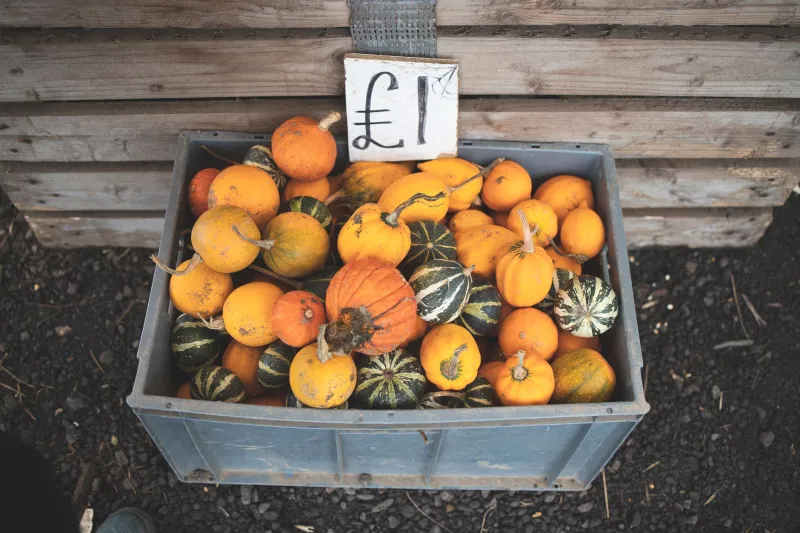
Price cards should be big, plain and repeatable. A5 is usually enough for a main item; A6 works for smaller things. Put the item name in a bold line, the price underneath in a larger size, and keep the wording short. If there is a unit—per 100g, per bunch, per bag—say so clearly. If card payments are accepted, a small card-machine symbol near the till saves a hundred repeated questions.
Matt lamination is worth considering for anything that will be handled, propped against jam jars or wiped down after a wet morning. A heavier card stock also stops the corners curling in damp air. But do not over-engineer every card. If your prices change with the season, print a batch of blanks or leave the price area clean enough to add a printed sticker later. The card is a working tool, not a framed certificate.
The price card earns its keep
A good price card does three jobs at once. It gives the number, it gives the unit, and it gives the customer permission to decide. That last part matters. A stall with handwritten scraps of paper can be charming, but it can also suggest that nobody has thought about the buyer's experience. A tidy card says the opposite without any sales patter.
For Highland stalls, the practical details matter as much as the design. Use clips, small wooden stands or weighted holders rather than tape. Tape fails in cold, wet conditions and leaves a sticky mess on the table. If you sell food, keep allergen information in a separate, clearly printed sheet or folder—not squeezed onto the price card. If you have Gaelic names for products, print them consistently and give yourself room; do not cram a bilingual label into a space meant for one line.
The price cards are also the item most likely to need reprinting often. That is fine. A short run of 50 or 100 cards, printed locally, is cheaper than redoing a whole display system. Keep a master file with your standard sizes and fonts, and update only the numbers when they move.
Stickers, slips and the small rituals
Bag stickers are the quiet workhorse of a market stall. A simple printed sticker with your business name, a short web address and perhaps a line about where to find you next does more than decorate a paper bag. It seals the bag, labels a pre-order and gives the customer something to keep. A roll of 500 lasts a long time and does not take up much crate space.
Order slips are less glamorous but just as useful. If you take pre-orders for collection, a duplicate pad or a simple numbered slip keeps things straight when three people want the same thing. Print a batch with your stall name, a space for the order, a collection date and a contact number. It looks more professional than the back of a receipt, and it gives you a paper trail when the signal drops.
What you do not need is a bespoke loyalty card for a stall that trades twice a month. Keep the small rituals simple. A sticker, a slip and a clear card are enough.
Weatherproof signs and the banner you buy once
Outdoor market signs need to survive more than a design review. A lightweight foam board is fine for a sheltered hall; it is not fine on an exposed street with a westerly coming down the glen. For outdoor use, look at corrugated plastic or rigid PVC, with eyelets if the sign needs to be tied down. A weighted base is not a luxury. Neither is a sign that can be wiped dry.
Keep the wording on outdoor signs short: stall name, what you sell, card payments, maybe a QR code. Do not rely on the QR code alone. In a bad signal area, a printed web address and a clear stall name are more useful than a square that will not load.
The table banner is the item to print once and print properly. Choose a sturdy material, keep the design free of dates and seasonal slogans, and make sure the colours still work in grey November light. A plain banner with your name and a short line about what you do will last for years. A banner advertising a specific Christmas market will last one weekend. If you need seasonal messaging, put it on a smaller removable sign, not the main banner.
What to print once, what to reprint, what to leave
Print once: the main table banner, a sturdy outdoor sign, a simple allergen folder and a master set of display holders. These are infrastructure. Buy well and they disappear into the background.
Reprint often: price cards, order slips, bag stickers and any sign with a date or a market-specific detail. Keep the runs modest. A hundred price cards that are out of date by February are not a bargain.
Leave it: glossy menus for a stall that changes weekly, giant pop-up banners for a windy square, and hundreds of loyalty cards for a business that has not yet worked out its repeat customers. Print should reduce friction, not add another box to carry.
A good market kit fits in one crate and comes out in the same order every time. The price cards go up first. The stickers and slips sit by the till. The banner is tied down before the first customer arrives. None of it is expensive, and none of it needs to be clever. It just needs to make the table feel like someone is expecting you.
That is the real job of small print at a Highland stall. It is not decoration. It is the handshake on the table, repeated fifty times before lunch.