The Counter-Space Test: A Highland Christmas Gift Guide That Shops Want to Keep
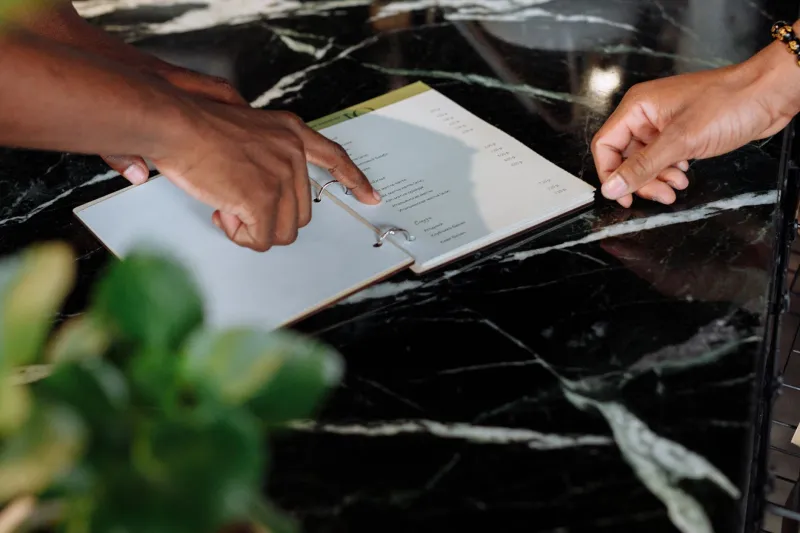
Photo: A5 Christmas gift guide booklet on independent shop counter in Scotland, via play-lh.googleusercontent.com
Every November, someone in Inverness has the same good idea: a Christmas gift guide for local independents. It gets a page on a website, a few social posts, and about eleven shops involved. By mid-December it has vanished, and everyone quietly agrees the internet is probably fine.
The better version isn't cleverer. It's just built for the place it's going to live: a counter by a till, a stack by a library door, a table at a festive market with mulled something sloshing nearby. If a guide can survive that, it earns its keep. If it can't, no amount of design will save it.
Start with the shelf, not the spreadsheet
The instinct is to design first and sell advertising afterwards. Turn that round. Before anyone opens a layout program, walk into ten shops you'd actually want in the guide and ask one question: would you keep a free A5 booklet on your counter for three weeks in December?
You'll get three sorts of answers. Yes, happily. Yes, if it looks decent. And a polite no, which usually means their counter is already crowded with charity boxes and a card machine. That last answer is the most useful one you'll get all month, because it tells you the real constraint isn't demand — it's space.
Aim for a guide that fits in one hand and lies flat. A5 portrait, roughly 24 to 32 pages, is the sweet spot for a Highland run. Anything thicker gets treated as a magazine and moved somewhere less visible. Anything flimsier gets mistaken for a leaflet and recycled by teatime.
The arithmetic of a small run
Printing works in multiples of four, because pages are printed on big sheets that get folded. So decide your page count in fours before you promise anyone anything. Twenty-four pages is a comfortable target: a cover, a contents page, maybe eighteen pages of listings, and a page or two for vouchers and a map.
At a typical Highland quantity — say 2,000 copies — a 24-page A5 guide on decent uncoated stock lands somewhere in the region of £600 to £900 depending on paper and finish. That's a working figure, not a quote; ask for one. The point is that the print bill is knowable early, which means your ad rates are too.
If the print and design costs come to £1,200, and you sell twenty half-page slots at £60, you've covered it with a small buffer. That's a realistic local rate for a first-year guide with a distribution of two thousand. Don't inflate it. A guide that pays for itself and comes back next year beats one that makes a profit once and never reappears.
Selling the slots without a sales team
Most people who try this are not salespeople. They're a printer, a community group, a business association, or one person with a laptop and a good relationship with half the high street. Play to that.
A simple three-tier structure works: a full page, a half page, and a shared quarter-page block for very small businesses — a mobile hairdresser, a candle maker, a joiner who does bespoke gifts. The quarter-page tier matters more than it looks. It's where the interesting Highland businesses live, and it's what stops the guide reading like a directory of estate agents.
Ask each advertiser for one thing beyond the payment: a line about what they'd actually recommend as a gift. Not a slogan. A recommendation. "The heather candle, because it's the one people come back for." That single sentence is what makes a printed guide more useful than a social post, and it takes them ten seconds to write.
Include a vouchers page. A page of tear-out or photograph-and-show offers gives readers a reason to keep the booklet past Boxing Day, and it gives advertisers a measurable return they can mention when you ask them again next year.
Paper that survives December
Glossy covers photograph beautifully and show every thumbprint. Uncoated or silk stock at around 130–170gsm for the cover and 100–120gsm inside is the practical choice: it takes a pen, it doesn't glare under shop lighting, and it doesn't crack at the spine after a week of being opened and shut.
If the guide will sit by a door — and in the Highlands in December, it will — ask your printer about a light matt lamination on the cover only. It wipes clean and stops the corner curling the first time someone picks it up with wet hands. Skip it inside. There's no need to pay for durability on page eleven.
One more thing: get a paper proof. A PDF on a screen hides everything that matters here — how the stock feels, whether the text is readable at arm's length, whether the cover still works under a shop's warm lighting. Hold it to the window in the same way you'd hold a colour swatch, and you'll spot the problems before two thousand copies do.
Where the copies actually go
The mistake is assuming shops will distribute for you. They'll host a stack; they won't top it up. Build a simple route and a simple rota.
- Shops that advertised: two deliveries, one at the start of December and one mid-month.
- Libraries and leisure centres: ask first, deliver early, and label the box clearly with a contact number.
- Festive markets: a bundle per stall rather than a pile on a table, so it doesn't blow into the Ness.
- The spares: keep a hundred back. You will need them for the people who ring in January asking for one.
Print a small line on the back cover saying where else to find a copy. It sounds trivial. It's the difference between a guide that circulates and one that sits in a single shop in Dingwall.
The deadline is the product
A Christmas gift guide has one unforgiving feature: it must be out before the Christmas shopping actually starts, which in the Highlands means the last week of November at the latest. Work backwards from that date and be brutal. Copy deadline, artwork deadline, proof approval, print, delivery. Leave a clear week for the thing you haven't thought of, because there is always a thing.
And when it lands, resist the urge to measure it in clicks. Measure it in stacks. Ring the shops in the second week of December and ask a single question: are you down to your last ten? If the answer is yes in most of them, you've made something the town wanted. That's the only metric a printed guide really needs.