Maps, Chairs and a Failing Projector: What Belongs on the Consultation Table
There is a particular kind of Highland meeting that starts with chairs being dragged across a village hall floor and ends with someone asking whether the map can be seen from the back. In between, a community trust, a developer or a planning consultant tries to explain something complicated about land, access, housing or a change of use. The stakes are real. Crofters, parents, holiday-home owners, shopkeepers and committee members all arrive with different amounts of time and different levels of patience.
Print is not the bureaucratic bit of that evening. It is the part that lets everyone in the room work from the same information. A good consultation table does not replace conversation, but it gives the conversation somewhere to stand.
Start with the room, not the slides
Most consultation print is designed on a laptop and then tested in a room that is nothing like the laptop. The result is a set of A4 handouts with a map reduced to the size of a postage stamp and a summary written for people who already know the project. That is not a communication failure. It is a print failure.
Before anything goes to press, ask what the room will actually need. If the meeting is in Beauly or Ullapool on a wet Tuesday in February, people will arrive in coats and boots. They will be holding gloves, car keys and perhaps a child’s homework folder. The print has to be easy to pick up, easy to hold and easy to read under hall lighting that was last upgraded sometime before the internet.
That usually means one large-format map, a one-page plain-English summary, a sign-in sheet, a feedback form and a small number of accessible copies. Not a glossy brochure. Not a 40-page document that nobody will read at 8pm.
The big map earns its keep
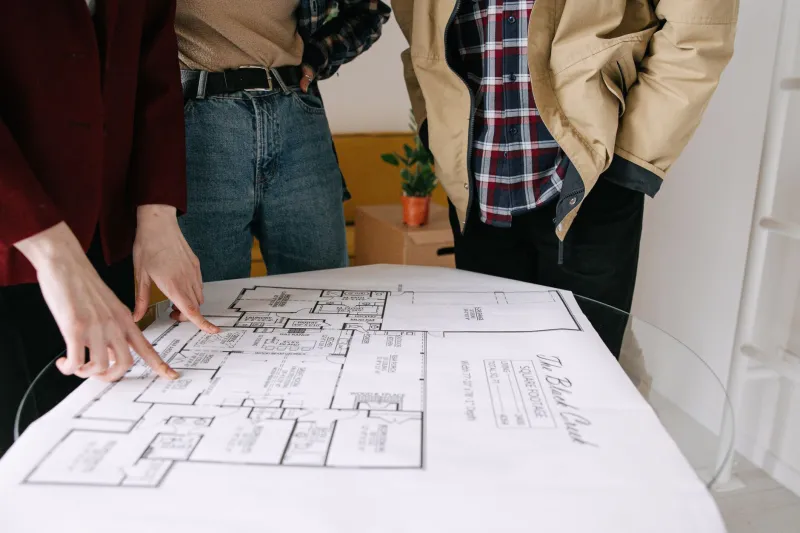
A large-format map is the single most useful piece of print at most land meetings. It does not need to be beautiful. It needs to be legible. Boundaries should be clear, labels should be large enough to read from a couple of metres away, and the key should sit on the same sheet rather than on the back. If people have to ask where something is, the map is already doing half its job.
In the Highlands, the map also has to cope with local knowledge. Someone will point out a drain, a right of way, a favourite dog-walking route or a patch that floods every November. A printed map can be marked up with a pencil and kept as a record. A projected map cannot. When the projector fails — and it will — the printed map becomes the meeting.
Plain English is not a luxury
Planning and land documents are full of terms that make sense to the people who wrote them and very little sense to everyone else. Consultation print should translate, not repeat. A one-page summary with short paragraphs, clear headings and a simple ‘what happens next’ section will do more for trust than a hundred bullet points lifted from an application.
This is not about dumbing anything down. It is about respecting the audience. A crofter reading about access rights, a parent reading about a path to school and a holiday-home owner reading about parking all need the same thing: the plain version first, with the detail available if they want it.
Sign-in, feedback and the paper trail
There is a quiet practicality to sign-in sheets and feedback forms. They show who was in the room, what was raised and what still needs an answer. They also give people who do not want to speak a way to contribute. Not everyone is comfortable putting a hand up in a hall. Some would rather write three sentences on a form and hand it in at the door.
Keep the forms simple. Space for a name if people are happy to give one. Clear boxes or lines for comments. A note on where the feedback goes and by when. And a box for people who want to be kept in touch. That last part matters in small communities where the same six people often end up carrying the follow-up.
Accessible copies and the quiet table
A consultation evening should have a small stack of accessible copies: large-print summaries, a few copies with clear contrast, and perhaps a version in plain text for anyone who finds dense layouts difficult. These do not need to be on every chair. They need to be on a table where people can ask for them without making a fuss.
It also helps to have a quiet table away from the main scrum. In a busy hall, the person who most needs to read the detail may be the least likely to stand in a queue. A chair, a clear copy and a pencil can do a lot of work.
A short kit list for the van
The print pack for a well-run consultation is not complicated. A large-format map. A one-page summary. A sign-in sheet. A feedback form. A few accessible copies. A roll of masking tape. A couple of pencils. And a spare copy of everything kept flat in the van, because the projector may fail, the hall may be locked and the weather may turn.
None of this is bureaucracy for its own sake. It is how a complicated land decision becomes something a room full of people can actually look at, discuss and respond to. In the Highlands, that is not a small thing. It is the difference between a meeting that happens to people and a meeting that includes them.