The Gate Is the Shopfront: Printed Cues for a Highland Honesty Box
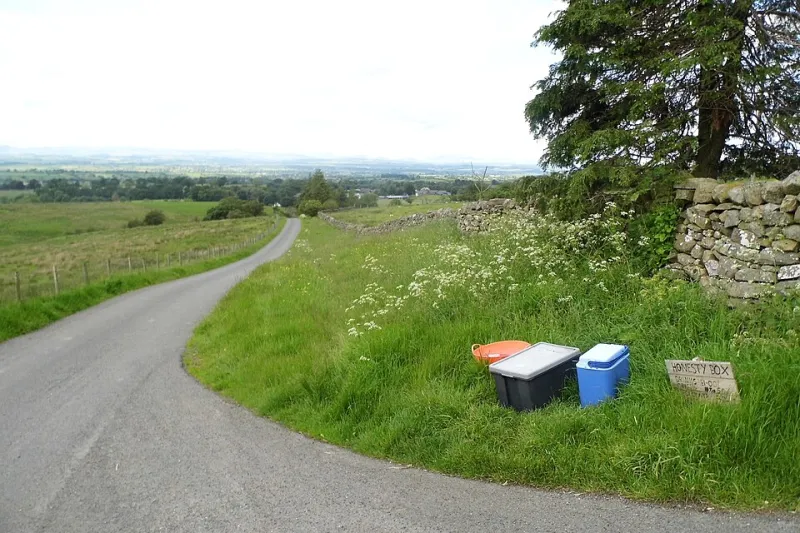
Photo: Anthony Parkes , CC BY-SA 2.0, via Wikimedia Commons
Drive any back road out of Inverness — towards Beauly, up Strathglass, across the Black Isle — and you will pass a cool box, a wee shelf, or a tin with a slot cut in the lid. Eggs, tatties, jam, kindling, maybe a few bunches of daffodils in spring. The honesty box is a familiar bit of Highland retail, and it runs on a simple bargain: the customer takes what they need and leaves the right money.
But the bargain only works if the print does its job. A gate with a handwritten card and a jam jar can feel charming for a week. A gate with a proper sign, clear prices and a receipt slip feels like a shop. That difference matters. The print is not decoration. It is the staff.
Before the coin jar: the first sign
Most honesty boxes fail at the entrance, not at the box. If a driver cannot see what is for sale from the road, they will not stop. If they stop and cannot tell whether the eggs are £2 or £3, they will hesitate. Hesitation is the enemy of the small sale.
A gate sign needs three things: what you sell, when you sell it, and what to do next. Keep it short. A3 is usually enough. Fix it at a height that suits both a car window and someone on foot. Use 3mm correx for a temporary sign, or a rigid aluminium composite panel if the gate is a permanent shopfront. Do not laminate a sheet of A4 and staple it to a post. Water will find the staple holes, the ink will run, and by February the sign will look like a lost cause.
Stainless screws and cable ties are worth the small extra cost. Highland weather does not negotiate.
Price cards that read in low light
Price cards are where most honesty boxes lose their nerve. A5 is a good size. Put the item name at the top, the price underneath in figures that are at least 24pt, and the unit — half dozen, kilo, bunch — in plain words. Avoid decorative fonts. Avoid pale grey on white. A customer in a hurry, with the engine running and the wipers on, needs contrast.
For outdoor cards, print on polypropylene or encapsulated paper, not standard card stock. If you are using an acrylic holder, drill a small drainage hole in the bottom corner. Condensation is persistent. For a shelf inside a cool box, a laminated card is usually fine, but wipe it dry before the season starts.
A useful trick is to print a small set of cards for the whole year in one go: eggs, tatties, jam, kindling, seasonal gluts. Keep them in a labelled envelope in the house. When the box changes, the cards change. It sounds obvious, but the honesty boxes that look cared for are the ones that get repeat custom.
Instructions in three lines
The instruction board is not a legal document. It is a nudge. Three lines is plenty:
- Eggs £2.50 a half dozen
- Money in the tin, please
- Thank you — exact change appreciated
Add a line about card payments only if you actually have a reliable signal and a working reader. In many Highland glens, a QR code on a gate is a hopeful gesture rather than a payment method. If you do use one, print it at least 4cm square and test it from the road. A code that needs two bars of signal and a steady hand is not a service; it is a puzzle.
For a community larder or a shared produce shelf, the instructions need one more line: take what you need, leave what you can. Print that in the same size as the prices. It sets the tone better than a paragraph of explanation.
The paper trail that builds trust
A receipt slip is not about bureaucracy. It is about the small, civil moment of acknowledgement. A duplicate pad of 100 slips costs less than a bag of layers' pellets, and it changes the feel of the transaction.
Print simple fields: date, item, amount, initials. Keep a pencil on a string. The customer fills in the top copy and drops it in the tin; you keep the carbon copy. Or the other way round. The point is that both sides have a record. If someone is short by 50p, the slip explains it. If a neighbour wants to settle up at the end of the month, the ledger explains it.
The ledger itself can be a hardback A5 notebook with columns for date, item, cash in, cash out and notes. It is not surveillance. It is a way of answering the question that every honest box eventually faces: what actually went through the gate this week? A printed ledger page, with a few ruled columns and a heading, is easier to keep than a blank notebook. It also looks deliberate, which encourages deliberate behaviour.
The brand moment
A well-made honesty box sign does something a jam jar cannot. It gives the gate a name. It says who you are, where the produce comes from, and how to get in touch if something is wrong. That is a brand, in the plainest sense.
You do not need a logo. You need a clear name, a short line of description and a phone number. Something like: Glen Road Eggs — free range, collected daily — 01463 000000. Print it on the main board and repeat it on the receipt slips. If you sell at a farmers' market, use the same card design. Consistency is what makes a roadside box feel like a proper local business rather than a happy accident.
At Torna Press Inverness, we see a lot of small print jobs that are really trust jobs. The honesty box is one of the clearest examples. A few well-chosen pieces of print — a gate sign, a set of price cards, an instruction board, a duplicate pad and a ledger — turn a jar of coins into a shopfront. The customer feels fair. The seller feels organised. The gate keeps working through the winter.
A short kit list
- A3 correx or composite gate sign
- A5 polypropylene price cards in a drained holder
- A4 instruction board with three clear lines
- Duplicate receipt slips and a pencil on string
- A5 hardback ledger with printed columns
- Stainless fixings and a spare set of cards in the house
None of it is expensive. All of it is easier to replace than a reputation for vagueness. And in a place where the weather does most of the talking, a sign that still reads in February is worth more than a hundred jam jars.